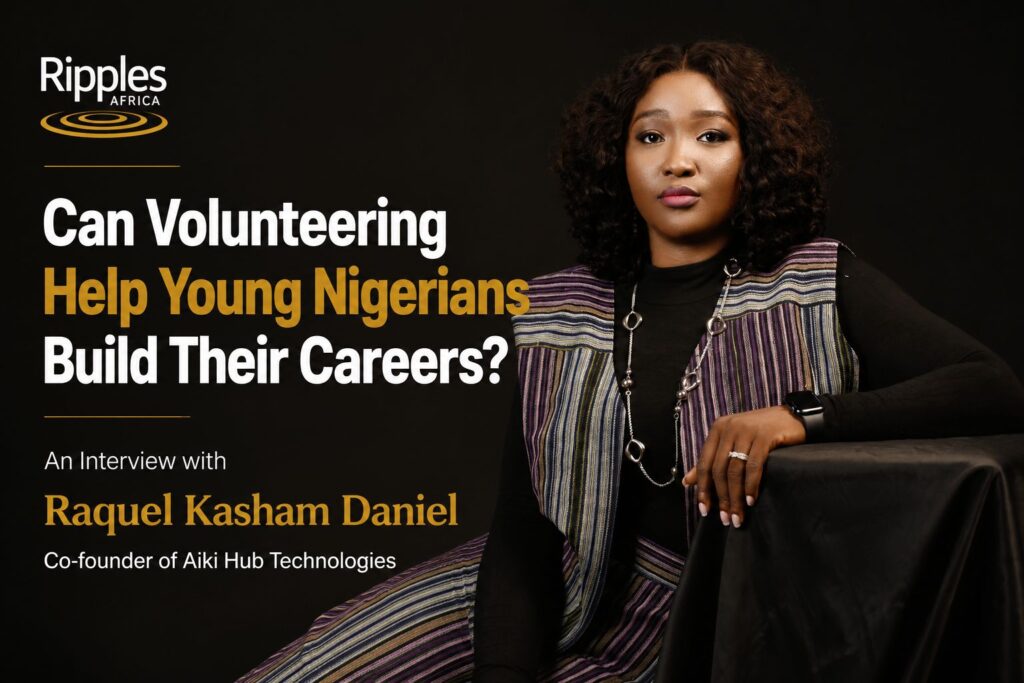
Can Volunteering Help Young Nigerians Build Their Careers?
Volunteering is often seen as something people do in their spare time, but for many young Nigerians, it can be a pathway to skills development, leadership, networking, and career growth.
As conversations around youth unemployment, employability, and civic engagement continue, volunteering remains one of the most accessible ways for young people to gain practical experience while contributing to causes they care about.
To better understand the role volunteering can play in shaping careers and strengthening communities, we spoke with Raquel Kasham Daniel, a social entrepreneur working at the intersection of technology, media, and social impact.
Raquel is the Co-founder of Aiki Hub Technologies, a social innovation company that builds technology-driven solutions and programs designed to create opportunities and strengthen communities. One of its flagship platforms is Voluserve, which helps volunteers and nonprofits in Nigeria find each other more easily.
Over the years, she has worked with nonprofits, young people, and development organizations across Nigeria, leading initiatives focused on education, youth development, community resilience, and social impact.
In this conversation, she shares how volunteering shaped her own journey, why she believes more young Nigerians should volunteer, and how technology can help create more pathways for service, learning, and impact.
Question 1: Tell us a bit about yourself and the work you do.
My name is Raquel Kasham Daniel and I work at the intersection of technology, media, and social impact.
I’m the Founder of Beyond the Classroom Foundation, a nonprofit organization focused on education, child protection, and creating opportunities for vulnerable children and young people. Over the years, our work has reached thousands of children and young people across Nigeria through education, safeguarding, mentorship, and community-based interventions.
I’m also the Co-Founder of Aiki Hub Technologies, a social innovation company that builds technology-driven solutions designed to help people learn, work, serve, and connect. One of the platforms we’re currently building is Voluserve, which helps volunteers and nonprofits in Nigeria find each other easily.
For over a decade, I’ve worked across the nonprofit, media, and development sectors, designing programs, building communities, managing volunteers, and using storytelling and technology to drive social impact.
At the heart of everything I do is a simple belief: when people have access to the right opportunities, tools, and support, they can create meaningful change in their communities.
Question 2: How long have you been involved in volunteering and what first drew you to it?
I’ve been involved in volunteering for over a decade now.
My first structured volunteering experience was with AIESEC Nigeria while I was in university. At the time, I wasn’t thinking about building a career in the social impact space or starting a platform around volunteering. I was simply looking for opportunities to learn, grow, and contribute.
What I didn’t realize then was how much volunteering would shape my life.
Through volunteering, I gained leadership experience, built lifelong friendships, travelled, worked with people from different backgrounds, and developed skills that I still use today.
Volunteering also gave me opportunities that I probably wouldn’t have had otherwise. It exposed me to new ideas, new communities, and new possibilities.
In fact, I met my husband through a volunteering opportunity, so volunteering has influenced both my personal and professional journey.
Over the years, I’ve been on both sides. I’ve volunteered, and I’ve also recruited, trained, and managed volunteers through the different organizations and projects I’ve led.
That’s one of the reasons I’m so passionate about volunteering today. I’ve seen firsthand how powerful it can be, not just for the communities being served, but for the volunteers themselves.
Question 3: Many young Nigerians are focused on getting jobs. Why should they also consider volunteering?
I actually think volunteering is one of the most underrated ways for young people to prepare for the opportunities they are looking for.
A lot of people are waiting for someone to give them experience before they can get a job, but volunteering is one of the ways to gain that experience in the first place.
Through volunteering, you learn how to work with people, communicate effectively, solve problems, manage projects, and take responsibility. These are skills employers are looking for, regardless of your field.
Beyond the skills, volunteering also helps you build your network. Many opportunities come through the people you meet, the communities you join, and the work you do consistently over time.
Looking back, some of the experiences that shaped my confidence and leadership came from volunteering. It gave me opportunities to lead before I had a leadership title and to learn by doing.
I’m not saying volunteering automatically leads to a job, but I do believe it helps you build the skills, experience, and relationships that can open doors over time.
For many young people, especially those trying to gain experience, volunteering can be a great place to start.
Question 4: Some people believe volunteering is a waste of time because it doesn’t pay. What would you say to them?
I understand why some people feel that way, especially given the economic realities many young Nigerians are facing.
People need jobs. People need income. Those are real concerns.
But I don’t think the value of volunteering should only be measured by whether money changes hands.
Some of the most valuable things I’ve gained from volunteering were not financial. They were skills, relationships, exposure, confidence, leadership experience, and opportunities that came later.
I’ve seen people get jobs because of the experience they gained while volunteering. I’ve seen people discover their career path through volunteering. I’ve seen people build networks that opened doors they never expected.
Of course, volunteering shouldn’t replace paid work, and organizations should be mindful not to exploit volunteers. But I believe volunteering can be an investment in yourself and your future.
For me, volunteering has never been just about giving. It’s also been about learning, growing, and becoming.
And sometimes the return on that investment shows up in ways you never expected.
Question 5: Can volunteering help someone with little or no work experience stand out when applying for jobs?
Absolutely.
In fact, that’s one of the biggest advantages of volunteering.
Many young people find themselves in that difficult position where employers want experience, but they haven’t had the opportunity to gain any yet.
Volunteering can help bridge that gap.
If you’ve successfully managed an event, coordinated a team, handled communications, organized logistics, supported a project, or led an initiative as a volunteer, those are real experiences and real skills.
The key is being able to communicate what you learned and the value you brought.
When I’m reviewing applications or speaking with employers, what often stands out is not just what someone studied, but what they’ve actually done.
Volunteering gives you stories to tell. It gives you examples of leadership, teamwork, initiative, and problem-solving.
It shows that you’re willing to learn, contribute, and take responsibility.
For someone just starting out, that can make a huge difference.
I’ve seen people move from volunteering into internships, consulting opportunities, full-time jobs, and even leadership positions because they were willing to start somewhere and build experience along the way.
Question 6: What are some of the biggest challenges young Nigerians face when trying to find volunteer opportunities?
One of the biggest challenges is simply knowing where to look.
There are thousands of young people who want to volunteer, gain experience, support causes they care about, and get involved in their communities. The challenge is that opportunities are often scattered everywhere.
You find one opportunity on WhatsApp, another on Instagram, another through a friend, and another through a Telegram group. Unless you’re already connected to the right networks, it’s easy to miss out.
I’ve also seen situations where people are interested in volunteering but don’t know which organizations are credible or where their skills would be most useful.
On the other side, nonprofits are often struggling to find committed volunteers. So you have people looking for opportunities and organizations looking for support, but both sides are struggling to find each other.
I’ve experienced this challenge from both sides. As someone who has volunteered and as someone who has recruited volunteers for years, I kept seeing the same gap over and over again.
That’s part of what led to the creation of Voluserve. We wanted to make it easier for volunteers and nonprofits to find each other in one place instead of relying on chance, personal networks, or social media algorithms.
Question 7: Why did you decide to build Voluserve?
Voluserve was born from a problem I kept seeing over and over again.
For years, through Beyond the Classroom Foundation and other projects, I’ve recruited and managed volunteers. At the same time, I’ve also been a volunteer myself.
What I noticed was that nonprofits were constantly looking for volunteers, while many young people were looking for opportunities to gain experience, build skills, and contribute to causes they cared about.
The challenge was that both sides were struggling to find each other.
Opportunities were scattered across social media, WhatsApp groups, Telegram channels, and personal networks. Unless you knew the right person or happened to see a post at the right time, you could easily miss out.
I kept asking myself a simple question: Why should finding volunteer opportunities be this difficult?
We have platforms for jobs. We have platforms for housing. We have platforms for transportation. Why don’t we have a simple place where volunteers and nonprofits can find each other?
That’s how the idea for Voluserve started.
We’re building a platform that makes it easier for nonprofits to share opportunities and for volunteers to discover them. Beyond that, we’re also creating a system that helps volunteers build a record of service, access training, earn badges, and showcase their impact over time.
At the end of the day, Voluserve is really about making volunteering more accessible, more organized, and more rewarding for everyone involved.
Question 8: What makes Voluserve different from simply finding opportunities on social media or WhatsApp groups?
Social media is great for awareness, but it’s not designed to manage volunteering.
Today, many volunteer opportunities are shared on Instagram, WhatsApp, Telegram, LinkedIn, and that’s fine. The challenge is that opportunities get lost quickly. If you don’t see the post at the right time, you may never see it again.
With Voluserve, we’re trying to create a more structured experience.
First, organizations on the platform go through a verification process, so volunteers have more confidence about who they are engaging with.
Second, opportunities are in one place and easier to find.
Third, we’re building more than just a listing platform. Volunteers can build a profile, earn badges, access training opportunities, and gradually build a record of their service and impact.
For nonprofits, it’s also more than posting opportunities. They become part of a community and gain access to additional benefits that help them strengthen their volunteer management and visibility.
We’re still early in the journey, but the goal is to create an ecosystem, not just a notice board.
We want volunteering to be easier, more trusted, and more rewarding for everyone involved.
Question 9: What role can technology play in strengthening volunteerism in Nigeria?
I think technology can help solve some of the biggest challenges in the volunteering space.
One of those challenges is access. There are people looking for opportunities and organizations looking for volunteers, but they often struggle to find each other.
Technology makes it easier to connect both sides.
It also helps with trust, accountability, and visibility. Volunteers can discover opportunities more easily, organizations can reach more people, and everyone can keep a better record of engagement and impact.
For me, the future of volunteering is not just about getting more people to volunteer. It’s about creating systems that make volunteering easier, more accessible, and more rewarding.
That’s one of the reasons we are building Voluserve through Aiki Hub Technologies. We believe technology can help remove barriers and create more pathways for people to serve, learn, and contribute to their communities.
The easier we make it for people to find opportunities to serve, the stronger our communities become.
Question 10: What advice would you give to a young person who wants to start volunteering but doesn’t know where to begin?
My advice is simple: start where you are.
You don’t need to have everything figured out before you begin.
You don’t need to be an expert.
You don’t need years of experience.
Just start.
Find a cause you care about. It could be education, health, climate, community development, technology, faith-based work, or anything else that matters to you.
Then look for opportunities to contribute your time, skills, and energy.
Be willing to learn.
Be willing to show up.
Be willing to do the work, even when nobody is clapping for you.
Some of the opportunities that have shaped my life came from simply saying yes to volunteering and being willing to serve.
You may not see the impact immediately, but every experience teaches you something. Every opportunity helps you grow.
And you never know where one volunteer opportunity might lead.
For me, volunteering opened doors to leadership opportunities, lifelong friendships, a career in social impact, and even my marriage.
So don’t underestimate the power of showing up and serving.
You might be one opportunity away from a completely different future.
Question 11: What does success look like for Voluserve and the volunteering ecosystem in Nigeria over the next few years?
For me, success is not just about the number of people who sign up on Voluserve.
Success is seeing volunteering become a more visible and valued part of how we learn, work, and contribute to society.
I would love to see a future where young people can easily find opportunities to serve, gain experience, and build skills.
I would love to see nonprofits spend less time struggling to find volunteers and more time focusing on their impact.
I would love to see volunteering recognized as a legitimate pathway for learning, leadership, and career development.
And beyond Voluserve, I hope we can contribute to building a stronger culture of service in Nigeria, where more people see volunteering not just as something they do occasionally, but as a meaningful way to contribute to their communities and grow as individuals.
If we can help make that happen, I think we’ll be on the right track.