Independence, Culture and the Things We Must Not Lose
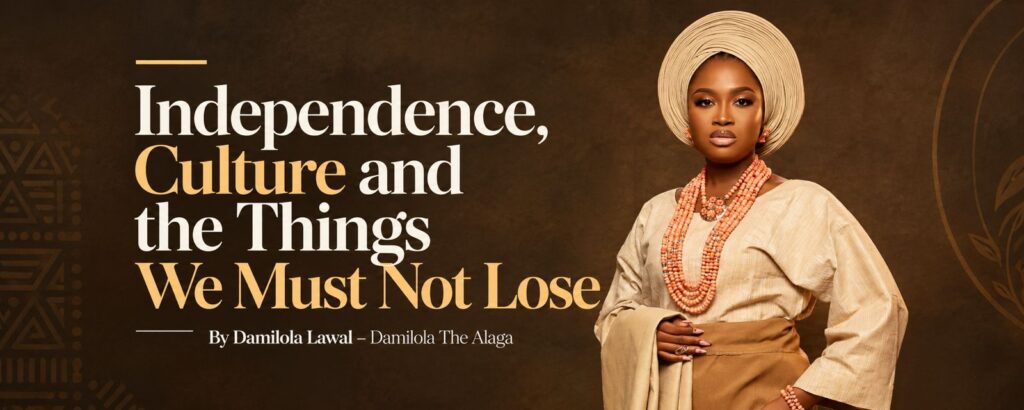
By Damilola Lawal – Damilola The Alaga
Every October 1st, we remember Nigeria’s independence. We talk about where we have come from, where we are today and the kind of country we hope to build. Independence gives us an opportunity to look at Nigeria not only as a political entity, but as a people with a history, an identity and a culture that existed long before 1960.
For me, that last part has become increasingly important because of the work I do.
As an Alaga, I work in a space where culture is not something we simply talk about. It is something we practise. At a traditional wedding, I am often standing in the middle of songs, chants, greetings, family traditions and ceremonies that have been passed from one generation to another. Some of these things are familiar to many of us because we grew up seeing them. Others are becoming less familiar as fewer young people learn them deeply enough to pass them on.
This has made me think differently about what it means to preserve culture.
Culture is often discussed as though it is something that belongs in a museum or something we bring out for special occasions. We wear traditional clothes, attend cultural festivals, dance to traditional music and post pictures online, but culture is much more than what is visible from the outside. It is also the knowledge behind those things. It is the meaning of a ceremony, the words of a song, the language in which a greeting is spoken, the reason a particular tradition exists and the stories that explain where we came from.
These are the things that can disappear quietly.
The more I have worked as an Alaga, the more I have understood that the role is not simply about being able to speak confidently into a microphone. It requires an understanding of the ceremony, the families, the language, the songs, the chants and the cultural expectations surrounding the occasion. You are constantly working with knowledge that came before you.
That is what makes the question of preservation particularly important to me.
There is a difference between preserving a culture and preserving a performance of culture. We can continue to have beautiful traditional weddings while gradually losing the knowledge that gives those ceremonies their meaning. We can sing songs without knowing what they mean. We can repeat words without understanding their history. We can participate in traditions without knowing why they exist.
When that happens, we may still have the appearance of tradition without fully carrying the knowledge behind it.
This is not an argument for keeping culture frozen in time. Culture has always evolved. Every generation adds something to it, interprets it differently and finds new ways to express it. The Yoruba culture I experience today is not identical to what existed generations ago, just as the weddings I conduct today are not exactly the weddings my parents experienced.
Change, therefore, is not the enemy of culture.
For me, the greater danger is disconnection.
When we stop learning the meaning behind what we do, when we stop teaching the language, when songs become sounds without context and ceremonies become performances without understanding, we create a gap between ourselves and the generations that came before us. And once that gap becomes wide enough, some things become difficult to recover.
This is one of the reasons I have become intentional about teaching the Alaga profession. Over the years, I have had the opportunity to train aspiring Alagas and to see people who are genuinely interested in learning the craft. That has shown me that there is an appetite for cultural knowledge. People want to learn. Sometimes, they simply need access to someone who can teach them.
That realisation also informed my decision to write The Alaga Handbook for Beginners.
The book is my attempt to document some of the things I have learnt through years of practising and teaching traditional compering. It covers traditional engagements, introduction ceremonies, intertribal weddings, songs and chants, ceremony etiquette and some of the practical realities of becoming an Alaga. It also includes recordings of traditional songs and chants that readers can access through a QR code, because some things are better learnt by hearing and practising them than by simply reading about them.
For me, that is what passing culture forward should look like.
We should not assume that the next generation will automatically know what we know. They will not. Every generation has to be introduced to the things that shaped the one before it.
And I think this applies far beyond Yoruba weddings.
Nigeria is home to hundreds of languages, communities, traditions, stories, forms of music, crafts and systems of knowledge. There are things our parents and grandparents know that have never been written down. There are languages becoming less commonly spoken. There are songs whose meanings younger people may no longer understand. There are crafts and practices that are becoming harder to find.
The responsibility of preservation cannot belong only to cultural institutions or historians. It has to be part of everyday life. It belongs in our homes, our schools, our creative work, our businesses and the spaces where we teach and raise the next generation.
We also need to make culture accessible to young people in ways that speak to the world they live in.
A young person should not have to choose between being modern and being connected to their culture. They should be able to use technology and speak their indigenous language. They should be able to build a career in a modern economy and still understand the traditions of their people. They should be able to create new expressions of culture without losing the knowledge that came before them.
Perhaps that is one of the things independence should mean to us now.
Not simply celebrating the fact that we became independent, but asking ourselves what we are doing with the identity we inherited.
Because nations are not built only through roads, institutions, businesses and technology. They are also built through memory, language, stories and the things people know about themselves and pass from one generation to another.
I have seen this firsthand in my work as an Alaga. A wedding can last for a few hours, but the songs, words, greetings and traditions within that ceremony carry histories much older than the people standing in the room. When I stand behind that microphone, I am conscious that I am participating in something that existed before me and that, in some small way, I am responsible for what happens to it after me.
That is why I do not think preservation should simply mean looking backwards.
It should mean carrying forward.
We should be able to honour where we come from while still creating something new. We should be able to preserve the knowledge that matters while allowing each generation to find its own expression. We should be willing to document what has traditionally been passed down orally, teach what we know and create opportunities for younger people to encounter their culture with curiosity rather than distance.
When the next generation looks back at us, I hope they will find that we did more than celebrate our culture. I hope they will find that we knew it, understood it, documented it, lived it and made room for them to carry it forward in their own way.
That, to me, is part of what independence means.
Knowing who you are, knowing where you come from and making sure you do not become the generation that allowed the things that made you who you are to disappear.