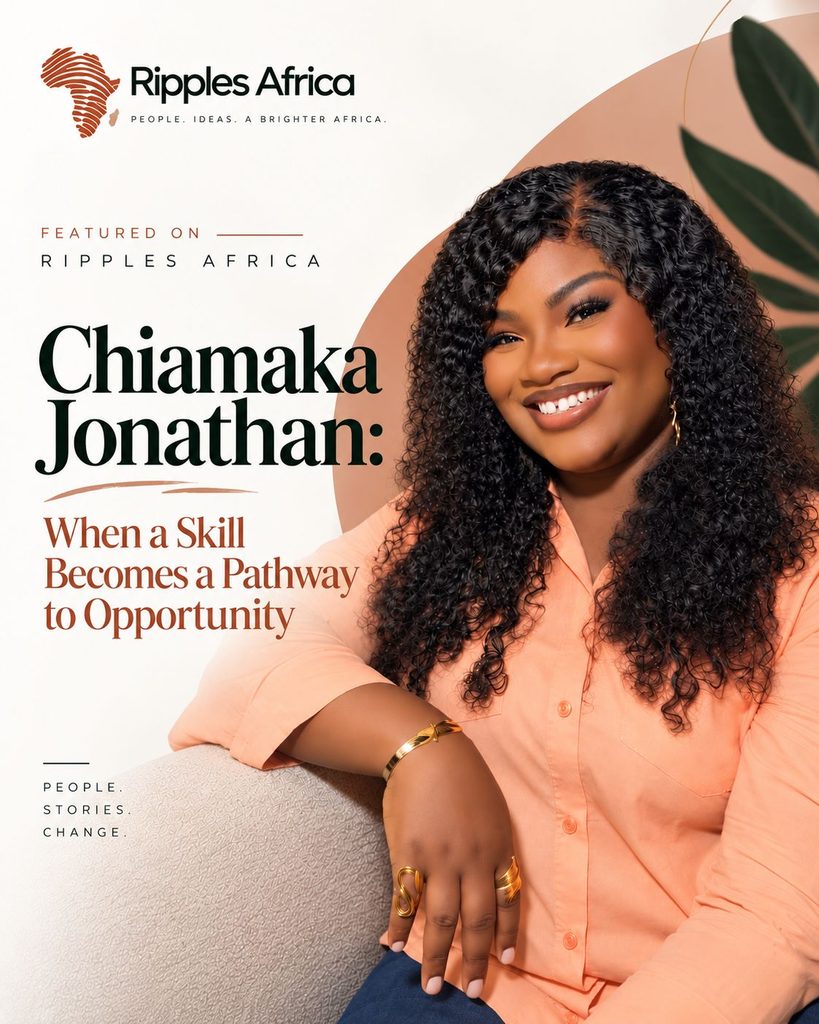
Chiamaka Jonathan: When a Skill Becomes a Pathway to Opportunity

When Chiamaka Jonathan began teaching women and girls how to make fascinators and hats, the work may have looked, at first, like a simple skills-acquisition initiative.
But for Chiamaka, it was never just about making hats.
It was about what a woman could do with a skill once she had it.
That idea has followed her through much of her career. From volunteering and youth leadership to entrepreneurship, programme management and women’s empowerment, Chiamaka’s work has consistently centred on one question: how can people, particularly women and girls, gain the skills and opportunities they need to have greater control over their lives?
Today, she is a development practitioner and social entrepreneur with more than eight years of experience implementing local and international projects across underserved communities in Nigeria. She is also the founder of Makys Concept, a fashion brand specialising in fascinators and beaded accessories.
But her journey did not begin with a job title.
It began with service.
Long before she was implementing development programmes or running a fashion brand, Chiamaka was involved in volunteering and youth leadership. Her contribution to service was recognised in 2020 by the United Nations Volunteers for her exceptional volunteering activities and contributions to the Sustainable Development Goals in Nigeria.
Her leadership journey also took her to the Young African Leaders Initiative (YALI) Regional Leadership Centre West Africa, where she participated in the Emerging Leaders Programme. She later served as Programme Officer for the YALI Network Abuja.
When she was elected to the role, Chiamaka publicly thanked members of the network for trusting her with the responsibility and said she would not take the opportunity to serve for granted. She also encouraged her colleagues to give their best wherever they found themselves, noting that they never knew what opportunity might come from it.
Looking at her career today, that emphasis on opportunity feels particularly fitting.
Because Chiamaka has spent much of her own career turning opportunities into something bigger.
Her leadership development continued through programmes and networks including the Savvy Fellowship, the United States Government Exchange Alumni Association of Nigeria and the Nigerian Prize for Leadership. She has also served as an Ambassador of the Street Project Foundation.
But alongside the leadership and development work, Chiamaka was building a business.
Through Makys Concept, she turned her interest in fashion and millinery into a brand specialising in fascinators and beaded accessories.
Then she began taking the skill beyond her own business.
She began teaching women and girls.
An earlier profile of her work records that she had trained 2,204 women and girls across Nigeria, Ghana, Côte d’Ivoire and Cameroon in hat making.
The number is significant, but what is more interesting is what the training was trying to achieve.
Chiamaka was working in the space between skills and opportunity.
For women facing unemployment or limited access to formal employment, learning a practical skill can create another route to earning an income. It does not solve every barrier, but it can give someone something with which to start.
That thinking was visible in Project Skill Up, a three-day skills-acquisition workshop designed to train 100 women and girls in Jahi 2, Abuja, as well as teenage girls from Girls Leading Our World in Lifecamp, in the production of fascinators. The project was explicitly designed around increasing access to skills, creating job opportunities and addressing unemployment among women and girls.
The choice of millinery was also significant because Chiamaka knew the work herself.
She was not simply delivering a vocational training programme because it was a development-sector requirement.
She was taking something she had built into a business and teaching others how they could use the same skill.
Makys Concept itself gained recognition beyond her immediate network, appearing among nominees for the 2020 Africa Youth Awards’ Startup of the Year category.
For Chiamaka, entrepreneurship and development were therefore not completely separate paths.
One gave her a business.
The other gave her opportunities to take what she knew into communities.
And as her professional experience grew, she moved further into programme management and development practice, working on local and international projects across underserved communities in Nigeria.
The work required a different set of skills: understanding communities, coordinating programmes, working with partners, managing implementation and thinking about how interventions could respond to real problems.
Her areas of interest have included health, education, gender equality and decent work and economic growth.
But women and girls have remained a consistent part of the picture.
In recent years, that work has taken her into one of the more difficult conversations around women’s empowerment: gender-based violence.
In 2025, Chiamaka was selected as an awardee of the European Union Youth Empowerment Fund, in partnership with the Global Youth Mobilization and the Big Six organisations, to implement Her Safety, Her Right in Nasarawa State.
The project focuses on gender-based violence while also looking at women’s economic empowerment.
That connection matters.
A conversation about GBV can easily remain at the level of awareness: what violence is, what it looks like, where to report it and how communities can prevent it.
But Her Safety, Her Right also brings in a more practical question: what happens when a woman’s economic circumstances affect the choices available to her?
At one of the project’s activities in Masaka Community, Nasarawa State, women engaged in a conversation around the intersection of economic independence and GBV prevention.
The discussion covered practical issues including acquiring income-generating skills, saving, owning assets, managing finances and investing in education.
These may sound like ordinary financial decisions.
For a woman who has little or no control over money, they can be much more significant.
Economic independence does not automatically protect a woman from violence, and skills acquisition alone cannot solve the problem of GBV. But access to income, assets, information and support can form part of the wider set of resources that influence the choices available to women.
That makes the connection to Chiamaka’s earlier work interesting.
Years before she was facilitating conversations around economic independence and GBV prevention, she was teaching women and girls how to make fascinators.
The two interventions are different.
But both begin with something practical.
One gives a skill.
The other builds knowledge around money, assets and independence.
Both ask what becomes possible when women have more resources and information available to them.
This broader approach is reflected in the Sustainable Development Goals Chiamaka advocates for, including SDG 3 on Good Health and Well-Being, SDG 4 on Quality Education, SDG 5 on Gender Equality and SDG 8 on Decent Work and Economic Growth.
Her work has increasingly sat at the intersection of these issues rather than inside one of them.
Education is connected to opportunity.
Skills can be connected to employment.
Employment can be connected to income.
Income can be connected to economic independence.
And economic independence can become part of a much larger conversation about women’s agency and safety.
That has also meant that Chiamaka’s own career has continued to expand.
She currently serves as the 2026 Director, Standard Performance Indicator, for Junior Chamber International (JCI) Abuja Metro, adding another leadership responsibility to a career that has already taken her through volunteering, youth leadership, entrepreneurship and development practice.
There are many ways to introduce Chiamaka Jonathan.
As a programme manager.
As a development practitioner.
As an entrepreneur.
As a volunteer.
As a youth leader.
As the founder of Makys Concept.
Each description is accurate.
But none of them tells the whole story.
The more interesting part is how one chapter has continued to lead into another.
Volunteering opened the door to leadership.
Leadership created opportunities to work with people and communities.
Entrepreneurship gave her a practical understanding of skills and income generation.
That experience became something she could share with women and girls.
Programme management gave her the opportunity to work on development interventions at a broader level.
And today, that experience is being brought into conversations around gender-based violence, economic empowerment and women’s safety.
Even the personal details available about Chiamaka are simple. An earlier profile describes her as someone who loves singing and listening to music. It is a small glimpse of the person behind the programmes, fellowships, community work and leadership roles.
Perhaps that is also what makes her story interesting.
It is not a story of someone who chose one thing and stayed there.
It is a story of someone whose work has continued to evolve as she has gained new skills, entered new spaces and taken on new responsibilities.
The fascinators were one chapter.
The volunteering was another.
So were the leadership programmes, the women and girls she trained, the development projects and the communities she has worked with.
Today, the questions are broader.
How can women gain skills?
How can those skills become opportunities?
How can women build greater economic independence?
And how can communities address the conditions that allow gender-based violence to continue?
Chiamaka’s work does not provide one answer to all of these questions.
But over the years, she has continued to work on different parts of the puzzle.
And perhaps that is the most interesting thing about her journey.
She started with service.
She found ways to turn skills into opportunities.
And as her work has grown, so has the size of the questions she is willing to take on.
The hats were never just about hats.
They were about what could happen when a woman was given something useful and the opportunity to do something with it.
That idea has travelled with Chiamaka Jonathan from the training room to development programmes, leadership spaces and communities in Nasarawa State.
And it appears to be far from the end of the journey.