Village Capital Invests $450,000 in Two Nigerian Startups Tackling Finance and Climate Challenges

Two Nigerian founders are getting fresh backing to scale businesses addressing some of the country’s biggest challenges — access to finance for small businesses and the growing problem of agricultural waste.
Global impact investor Village Capital has made its first investments in Nigeria, committing a combined $450,000 to two homegrown startups: Trade Lenda and AirSmat.
The investments were made through the Africa Ecosystem Catalysts Facility, a $4 million initiative designed to identify and support promising businesses across Africa that are solving critical local problems.
For the two founders, the investment provides more than capital. It gives their businesses additional room to expand solutions that are already being used by Nigerian businesses and farmers.
Helping small businesses access finance
Trade Lenda, founded by Adeshina Adewumi, is receiving $300,000.
The fintech company provides digital financing to small businesses and farmers, including business loans, embedded finance and Sharia-compliant financing options.
Access to affordable capital remains a major challenge for many African small businesses, particularly those that struggle to meet the requirements of traditional financial institutions.
Trade Lenda has built its business around closing some of that gap.
The company says it has already supported more than 260,000 SMEs and farmers across five of Nigeria’s six geopolitical zones, with women accounting for 66 percent of its customers.
The new investment will help the company deepen its lending operations and expand its reach.
The second investment, $150,000, goes to AirSmat, founded by Soji Sanyaolu.
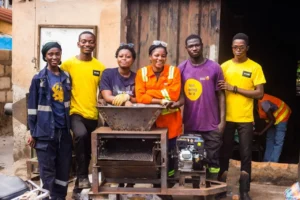
AirSmat is tackling a very different problem: what happens to agricultural waste after harvest.
The climate-tech company converts agricultural waste into biochar-based fertiliser, creating a product that can support soil health while also contributing to carbon removal.
AirSmat plans to use the investment to complete and commission its commercial biochar fertiliser factory and scale production.
For farmers, the model offers the possibility of turning what was previously treated as waste into an agricultural resource. For the climate sector, it creates another pathway for connecting agriculture with carbon markets.
Village Capital’s approach also highlights an important part of Africa’s startup ecosystem: local networks can be critical to finding businesses worth backing.
In Nigeria, Africa Fintech Foundry worked with Village Capital to identify the companies.
The partnership is part of Village Capital’s effort to find promising founders beyond the traditional venture-capital networks that can often favour businesses that are already highly visible to investors.
The two Nigerian startups are among the first companies backed through the Africa Ecosystem Catalysts Facility, which is also investing in businesses in other African markets.
For Trade Lenda and AirSmat, the investment represents an opportunity to move from solving problems at an early stage to reaching significantly more people.
One founder is working to make financing more accessible to small businesses and farmers.
The other is turning agricultural waste into a product with potential benefits for both farmers and the climate.
Together, their stories reflect a growing group of African entrepreneurs building businesses around problems that are deeply local, while creating solutions with the potential to scale far beyond their first markets.
Two founders. Two different problems. One increasingly important question for African business: how can capital help locally built solutions reach more people?